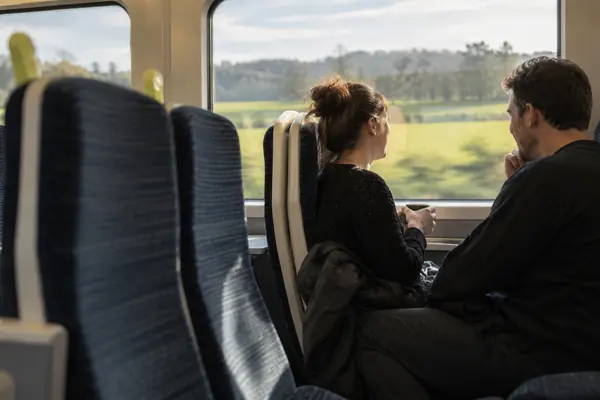
We expect talking to strangers to go badly. Studies suggest otherwise.
Psychology studies of commuters, students and workshop strangers point the same way: a quick hello tends to go better than we predict, and people like us more than we think after we talk.
AI-generated image, not a photograph of a real person or place.
Others want to talk too
Small chats count
You're liked more than you think
The research in three lines
THE SHORT ANSWER
Connection beats our expectations.
Three lines of research, one message: we are more cautious about saying hello than we need to be.
STRANGERS
Better journeys, not worse
Commuters asked to connect with a stranger had a more positive and no less productive journey. Others predicted the opposite, underestimating people's interest in talking.
Students felt happier and more like they belonged on days they talked with more classmates than usual. Everyday chats with acquaintances were linked to well-being.
After conversations, people underestimated how much their partner liked them and enjoyed their company, and the gap lasted for months among new dorm mates.
Pick a situation from the research to see what was found. The bar shows how well people knew each other.
From abstracts of studies published in the Journal of Experimental Psychology: General (2014), Personality and Social Psychology Bulletin (2014) and Psychological Science (2018).
TWO NUMBERS WORTH KNOWING
Loneliness is common, and young adults feel it most.
From the Department for Culture, Media and Sport's social connection framework, June 2026.
7%
Adults in England lonely often or always
The government's social connection framework gives this figure for all adults in England.
ADULTS · DCMS 2026
≈ 1 in 10
Young adults lonely often or always
The figure is higher among young people, rising to close to 1 in 10 among those aged 16 to 24.
AGED 16 TO 24 · DCMS 2026
Saying hello is not a cure for loneliness, but the studies suggest everyday contact with strangers and acquaintances adds to well-being.
FOUR WAYS TO START
Small steps, warm results.
Ideas drawn from what the studies tested.
Assume they're open to it
The commuter studies found people underestimate others' interest in connecting, so a stranger may be keener to chat than you expect.
Talk to the people you half know
Classmates, colleagues and regulars count. More of these small interactions went with happier days.
Answer when someone talks to you
Being on the receiving end of a conversation was as positive as starting one in the waiting-room study.
Go easy on yourself afterwards
Thanks to the liking gap, the other person probably enjoyed the chat more than you think.
AI-generated image, not a photograph of a real person or place.AI-generated image, not a photograph of a real person or place.
WHY WE HOLD BACK
A mistaken preference for solitude.
Epley and Schroeder found that people who were not asked to talk expected solitude to be more pleasant. That mistaken preference stems partly from underestimating others' interest, which stops people discovering what conversations are really like.
The authors conclude that people who misunderstand the consequences of social interaction may not, in at least some contexts, be social enough for their own well-being.
Questions
Questions people ask
Do people really want to be talked to on the train?
In one set of experiments, commuters asked to connect with a stranger had a more positive journey, while others predicted the opposite because they underestimated people's interest in talking.
Do chats with acquaintances make a difference?
A 2014 study found students felt happier and more like they belonged on days they talked with more classmates than usual, and weak ties were linked to social and emotional well-being.
What is the liking gap?
After conversations, people systematically underestimate how much their partner liked them and enjoyed their company. Researchers found it among strangers, new dorm mates and workshop participants.
Does the liking gap go away?
Not quickly. Among college dorm mates it persisted for several months as relationships developed.
How common is loneliness in England?
The DCMS social connection framework says 7% of adults are lonely often or always, rising to close to 1 in 10 among 16 to 24 year olds.